


Report finds Canada has real room to shape its China relationship, and charts a path of calibrated, differentiated engagement
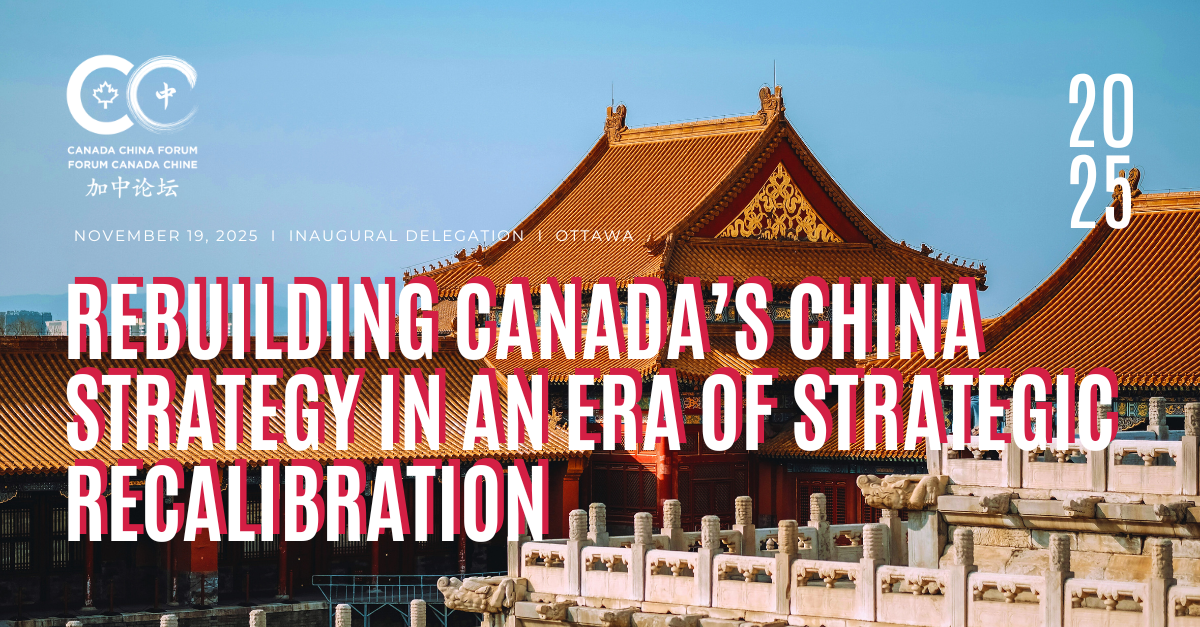
OTTAWA, October 2026 — The Canada China Forum released Emerging Leaders Dialogue 2025, the report from its inaugural dialogue held in Ottawa in November 2025. The report synthesizes the views of 32 delegates from industry, government, academia, and civil society on how Canada should navigate a relationship that is both consequential and deeply polarized.
The Emerging Leaders Dialogue was the first in Canada to convene a national dialogue of emerging leaders on Canada–China relations, bringing together delegates from coast to coast to coast.
The Dialogue met at the hinge of the Canada–China reset: weeks after Prime Minister Carney and President Xi held the first leaders’ meeting between the two countries since 2017, and two months before the Beijing visit that produced a new trade and economic roadmap.
About the Dialogue
The Emerging Leaders Dialogue was supported by the Honourable Yuen Pau Woo, Senator for British Columbia. Sessions were held under the Chatham House Rule, allowing participants to speak openly on sensitive questions; views in the report are unattributed.
“The future of the Canada–China relationship depends on the people who will carry it forward,” said Darren Touch, CEO of the Canada China Forum. “By bringing emerging leaders together from coast to coast to coast for the first national dialogue of its kind, we are investing in the next generation of Canadians who will understand China, engage with it thoughtfully, and represent Canada’s interests with confidence.”
The Dialogue also marked the 55th anniversary of diplomatic relations between Canada and the People’s Republic of China. Delegates were joined by Minister Counsellor Zhongzhou Li of the Embassy of the People’s Republic of China, and by the Co-Chairs of the Canada-China Legislative Association, Zoe Royer, Member of Parliament, and the Honourable Clément Gignac, Senator.
What delegates concluded
The report’s central finding is that Canada has more room to define its approach to China than is often assumed, and that a clear long-term strategy can turn that room into lasting results. Its principal findings:
- Framing drives policy. How Canada defines the China threat shapes every economic prescription that follows, and policy resting on intelligence that cannot be publicly tested risks a self-reinforcing narrative.
- China competency is thinnest when it is needed most. No major Canadian outlet had a reporter in mainland China, academic programs face cuts, and many Chinese-Canadians are withdrawing from public debate.
- Security concerns are real and widening. Technology has blurred the lines between commerce, data, and security, yet AI governance, climate, and global health remain necessary lanes of cooperation.
- Canada has more room to manoeuvre than its policy reflects. The January 2026 renegotiation of EV tariffs, cutting the 100% surtax to 6.1% within a 49,000-vehicle quota, shows the degrees of freedom exist when Ottawa uses them.
- Disengagement has a price. China’s 2025 retaliation hit more than C$2.6 billion in agri-food and seafood exports; delegates urged investment screening that distinguishes by sector, ownership, and region.
- Trust will be rebuilt bottom-up, through energy, agriculture, and climate cooperation, and through academic, business, and civil-society ties.
“This generation of leaders will inherit the Canada–China relationship, whatever shape it takes,” said Darren Touch, CEO of the Canada China Forum. “The Dialogue gave them a room to test hard questions candidly. The report shows how much ground there is between blanket restriction and uncritical engagement, and why Canada needs to choose its course deliberately.”
What remains unresolved
If the sessions converged on anything, it was that Canada’s approach to China still lacks strategic clarity, shaped more by domestic politics and news cycles than by a long-term plan. Events since add a caveat: much of the reset was assembled through channels that became public only after the fact, so the outside view may mistake sequencing for drift. Six questions follow:
- What does Canada actually want from China? A stabilized trading relationship, a hedge against dependence on the United States, or a broader strategic partnership? The answer determines how much risk is worth pricing in.
- Can the reset survive a shock? A foreign-interference finding, a Taiwan crisis, or US pressure in continental trade negotiations would test whether re-engagement has institutional depth or only momentum. Beijing’s warnings after an April 2026 parliamentary visit to Taiwan offered a first, modest test.
- Who rebuilds China competency, and who pays? Universities, newsrooms, and the government each hold a piece of the answer, but no one owns the file. The first two lack stable funding, and Ottawa has not made rebuilding China competencies and expertise anyone’s job.
- How should intelligence-derived claims be tested in public debate without either dismissing real threats or letting unverifiable assertions drive policy?
- Is calibrated policy a one-off, or a template? The EV quota and the March 2026 TikTok resolution, which replaced a wind-up order with binding undertakings and independent monitoring, both trade blanket measures for conditions. Whether that becomes the default across trade and investment files will reveal how differentiated Canada’s approach can become.
- How much of the relationship should run through quiet channels or Track 2 diplomacy? Much of the reset was negotiated out of public view and disclosed after the fact. That bought room to move, at a price in public accountability. Where the line sits between discretion and disclosure is itself a policy choice.
Looking ahead
The Forum aims to make the Emerging Leaders Dialogue an annual gathering where Canada’s emerging leaders take stock of the relationship and reflect on the year’s developments. The second Dialogue is planned for December 2026 in Toronto.
The Forum intends to hold future Dialogues in major cities across Canada. Each province and region has its own relationship with China, shaped by its trade, investment, communities, and institutions. Moving the Dialogue lets its programming reflect those regional realities and draw in leaders from each host community.
Sponsors and partners
The Forum thanks the Honourable Yuen Pau Woo, Senator for British Columbia, for his long-standing service on the Forum’s advisory board and for hosting the inaugural Dialogue.
The Dialogue was made possible by the support of:
- Canadian Meat Council
- Canada China Business Council, sponsor of the trade and investment panel
- University of Alberta China Institute and University of British Columbia Institute of Asian Research, whose travel stipends and institutional support brought a new generation of students and young professionals into the room
The report was drafted under the leadership of Daniel Lincoln, Chief Financial Officer of the Canada China Forum, with revisions from Forum members Jimmy Lou, Hannibal El-Mohtar, Colin Sawatzky, Dongwoo Kim, Arjun Gupta, Jacob Anderson, and Emma Huang. It was reviewed by the Forum’s Leadership Team: Rasdeep Singh, Alex Nanoff, Demetria Hu, Johnsen Romero, and Jonathan Kolodychuk. CEO Darren Touch provided strategic direction for the Dialogue and the report.
The Forum is grateful above all to the speakers, moderators, and delegates who engaged with difficult questions candidly and in good faith.
Read the report: Emerging Leaders Dialogue 2025 Report (PDF)